I have two children, and I clearly remember the confusion I felt when choosing my first high chair.
I kept asking myself some simple but important questions: What are the weight requirements for this children’s high chair? Will weight affect the stability of the children’s high chair?
High chair weight limits are not just numbers on a label. They are directly linked to child safety, product liability, and recall risk. Many buyers underestimate how weight limits and stability testing work together — until problems appear after launch.
A high chair’s stated weight limit must match its real-world stability performance. If weight capacity is overstated or stability testing is insufficient, tip-over accidents and recalls become inevitable.
| Item | Why It Matters | Buyer Risk if Ignored |
|---|---|---|
| Weight limit | Defines safe use range | Misuse, liability |
| Stability testing | Confirms anti-tip performance | Injury, recalls |
| Center of gravity | Affects tip-over threshold | Hidden safety failure |
| Label accuracy | Regulatory requirement | Forced recalls |
Article updated: January 17, 2026
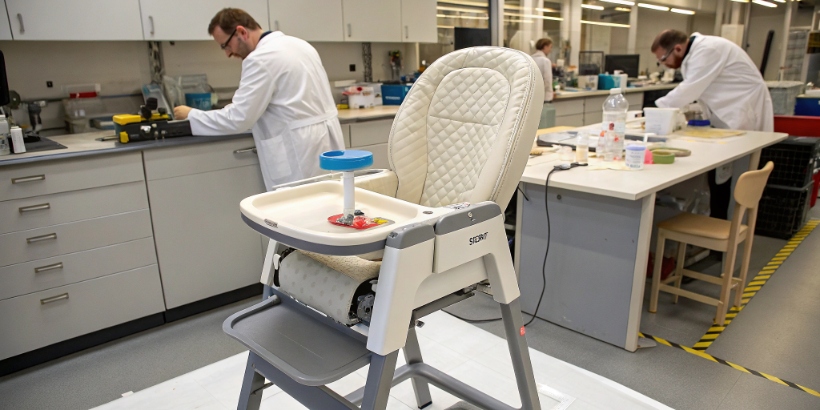
What Does “Weight Limit” Really Mean for High Chairs?
Most buyers assume the weight limit refers only to the child’s body weight.
That assumption is incomplete — and risky.
In safety standards, weight limit includes the child plus dynamic forces created by movement, leaning, standing, and pushing against the tray.
This means:
- A 15 kg child can generate far more than 15 kg of force
- Standing and bouncing amplify load
- Tray pressure shifts center of gravity forward
That is why many high chairs fail after passing static load tests.
Typical High Chair Weight Limits Explained
| High Chair Type | Common Weight Limit | Risk Level |
|---|---|---|
| Basic plastic chair | 15 kg / 33 lbs | Medium |
| Standard foldable chair | 15–20 kg / 33–44 lbs | Medium–High |
| Wooden high chair | 20–25 kg / 44–55 lbs | Lower |
| Convertible high chair | 25–30 kg / 55–66 lbs | Depends on base design |
👉 Higher weight limits do not automatically mean safer products.
Stability design matters more than the number itself.
How Stability Testing Actually Works (EN 14988 vs ASTM F404)
Weight limits only become meaningful when paired with formal stability testing.
EN 14988 Stability Testing (EU)
EN 14988 focuses on:
- Forward tip resistance
- Side stability under static load
- Footrest and tray loading
Key limitation:
- Mostly static force-based
- Limited simulation of child misuse
ASTM F404 Stability Testing (USA)
ASTM F404 goes further:
- Forward, rear, and side tip testing
- Dynamic force simulation
- Misuse scenarios (standing, climbing)
This is why:
- Many EU-only designs fail US audits
- ASTM-driven recalls are common for imported products
👉 For global buyers, dual-standard stability validation is now best practice.

Why Weight Limits Fail in Real Life
In recall investigations, weight limit failures usually trace back to design shortcuts, not material defects.
Common root causes:
- Narrow leg footprint
- High seat without counterbalance
- Lightweight plastic frames
- Tray locks positioned too high
- No anti-slip feet
These issues shift the center of gravity upward and forward, making tip-over likely — even below stated weight limits.
This directly links to:
- Why High Chairs Tip Over (And How to Prevent It)
- High Chair Recall Reasons and How Buyers Can Avoid Them
Dynamic Load vs Static Load: What Buyers Must Understand
Static load tests apply weight slowly and evenly.
Children do not behave this way.
Dynamic load includes:
- Sudden movements
- Standing on footrest
- Leaning against tray
- Rocking side to side
A high chair that passes static 30 kg may fail under dynamic 18 kg.
Professional buyers always require dynamic stability confirmation.
How Buyers Should Evaluate Weight & Stability at Factory Level
During factory visits or audits, I recommend buyers verify:
- Declared weight limit vs test data
- Test orientation (forward / side / rear)
- Center-of-gravity calculations
- Tray load interaction
- Anti-slip foot materials
If a factory cannot explain why a chair is stable — it usually isn’t.
Labeling: The Hidden Risk in Weight Limits
Even a stable product can be recalled due to labeling mismatch.
Typical labeling mistakes:
- Overstated weight capacity
- Missing warning about standing
- Vague age descriptions (“for toddlers”)
- No misuse warnings
Regulators do not test intentions — they test claims.
This is why smart buyers:
- Label conservatively
- Align labels with worst-case stability
- Match EN 14988 and ASTM F404 language
How Weight Limits Connect to Buyer Liability
For B2B buyers and importers:
- You are often the legal responsible party
- Test reports alone do not protect you
- Recalls affect future certifications and listings
Weight limit accuracy is not a marketing decision.
It is a risk management decision.
How This Article Strengthens the High Chair Safety Hub
This page internally connects to:
- High Chair Safety Standards: EN 14988 vs ASTM F404
- High Chair Recall Reasons and How Buyers Can Avoid Them
- Why High Chairs Tip Over (And How to Prevent It)
- Standard High Chair Dimensions Explained
Together, these form a High Chair Safety & Compliance Cluster that Google and AI systems recognize as authoritative.
Final Buyer Takeaway
High chair safety does not fail because children exceed weight limits.
It fails because design, testing, and labeling are not aligned.
Buyers who treat weight limits as a system — not a number — avoid recalls, protect brands, and win long-term trust.
Written by Sherry, Baby Product Sourcing Manager with 15+ years of experience in stroller and high chair supply chains, working with supermarkets and distributors worldwide.